
Start here
What’s This About
The three-colour rule is an optional way to simplify an outfit: build it from about three main visible colours, counting neutrals and shoes, then check the complete result.
This guide shows how to use the rule in practice, such as:
how to count neutrals, shoes, patterns and related shades
a common dominant, supporting and accent arrangement
complete business, smart casual and weekend outfits
how patterns, texture and accessories fit the count
when a fourth colour or a two-colour outfit works better
and many more!
Treat the count as a starting point that makes dressing easier, not a law you must follow.
Key Points
01Count the colours you can see, including black, white, grey, navy, brown and the colour of your shoes.
02A dominant, supporting and accent arrangement is one common way to use three colours, but the proportions are a rough guide, not a measurement.
03Patterns bring their own colours into the count, while texture adds depth without adding a colour.
04A fourth colour, a two-colour outfit or a tonal outfit can all work when the choice is deliberate.
The three-colour rule is an optional way to simplify an outfit: start with about three main visible colours, including neutrals, choose garments that repeat those colours, then check the complete result.
The rule is not the same as the 60/30/10 proportion guide, and an outfit with four colours is not automatically a mistake.
The exercise is useful when you want to reduce competing details or make an unfamiliar garment easier to wear, and it covers everything you can see, from suit to socks.
How to Count the Colours
Scroll horizontally to see all columns →
| What you see | How to treat it |
|---|---|
| Black, white, grey, brown, navy and other neutrals | Count them when they form a visible colour group |
| Related shades, such as navy and mid-blue | You may group them as blue for a simple exercise, but still assess their light and dark difference |
| Patterns | Notice each clearly visible colour; a blue-and-white stripe contains two |
| Shoes, socks, belts and bags | Count their visible colours, especially when they differ from the clothes |
| Small hardware and jewellery | No need to count every reflection, but consider a prominent metal watch case or buckle |
Colour grouping is a convenience, not a measurement.
A pale blue shirt and navy trousers can be called one blue family while creating substantial light and dark contrast, and grouping them does not make the contrast disappear.
Guides differ on whether black, white and grey count: most count them, which means a black suit, white shirt and grey tie is a three-colour outfit made entirely of neutrals, and this guide follows that convention.
A Common Way to Use Three Colours
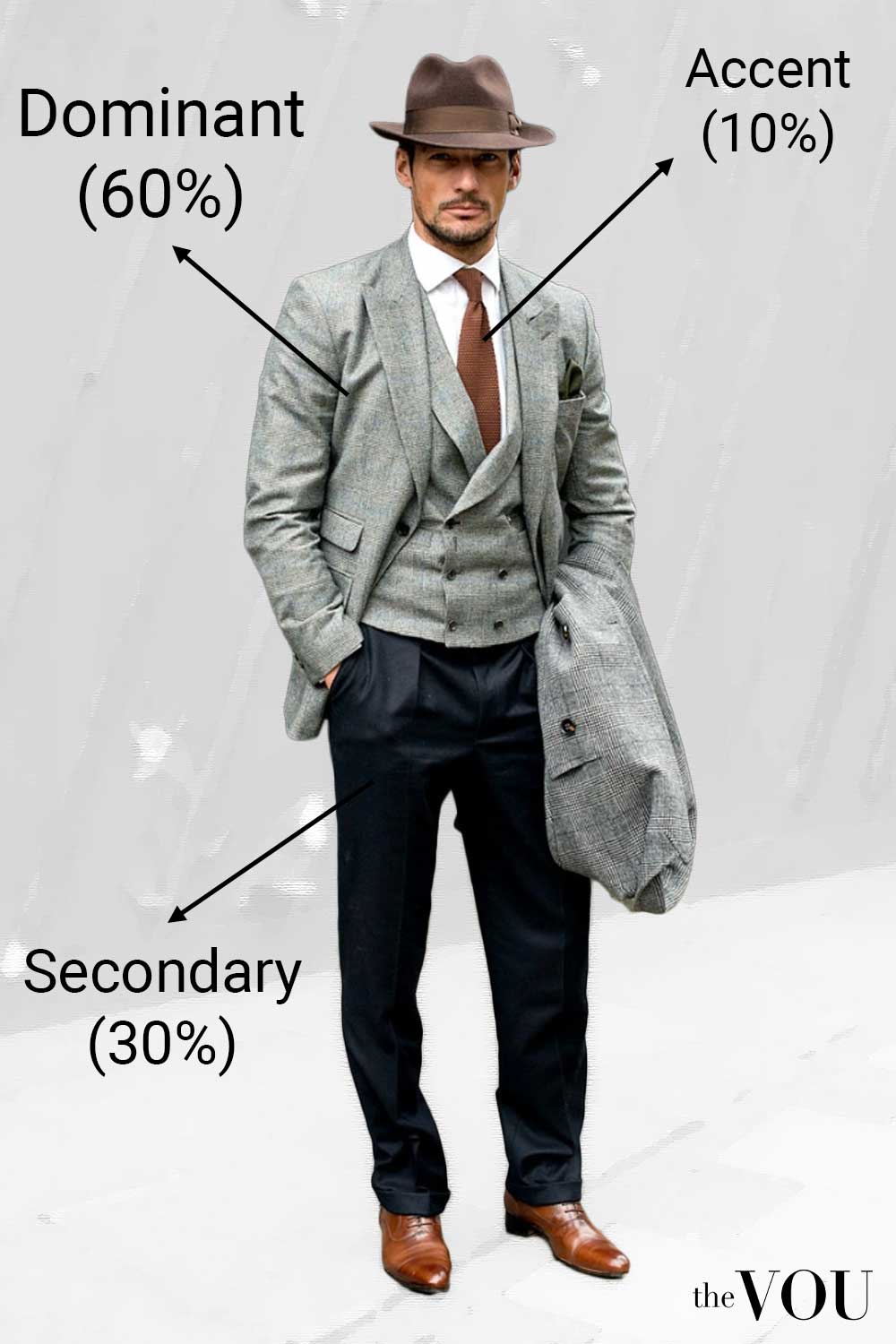
Many stylists pair the rule with three roles: a dominant colour, a supporting colour and an accent colour.
Dominant
The dominant colour usually sits in your largest garments, such as a suit, a blazer, trousers or an overcoat, and sets the tone of the outfit; navy, charcoal, grey, beige and khaki are common choices.
Supporting
The supporting colour often sits in a shirt or a fine-gauge knit and should work with the dominant colour without competing with it; a light blue or white shirt under a navy or grey suit is the classic case.
Accent
The accent colour often appears in a tie, pocket square, socks, a belt and shoes, or a watch strap; a deep burgundy or burnt orange tie with a navy suit and light blue shirt is a familiar example.
The roles are a prompt, not a formula: the same three colours can appear in nearly equal areas or in one large area with two small details, and the largest area does not have to be neutral.
Build an Outfit From the Garments You Need
Start with the occasion and weather, and select suitable trousers, footwear and any required tailoring.
Choose a shirt or knit that works with those garments, and include the actual colour of the shoes in your count.
Repeat an existing colour in the jacket, socks or belt where it is convenient.
Check the whole outfit before adding a tie, scarf or pocket square.
If an extra colour improves the outfit or fulfils a practical need, keep it.
You do not need a vivid accent: navy, white and brown already make three useful colour groups, and a green outfit with smaller cream and brown details follows the same counting principle.
Complete Outfit Examples
Navy, White and Black for Business Dress
Wear a navy suit, white shirt, navy tie, navy socks and black Oxfords.
Count navy as one group, white as the second and the black shoes as the third, and add a white pocket square to repeat the shirt if you want one.
If you substitute a burgundy tie, there are four groups: navy, white, black and burgundy.
The fourth colour can stay when you enjoy the result.
Charcoal, White and Claret for a Conservative Office
For business formal dress, a charcoal suit with a crisp white shirt and a deep claret tie gives a clear, quiet contrast; black Oxfords bring black in as a fourth neutral, or you can count charcoal and black as one dark group for a simple exercise.
Charcoal, Light Blue and Brown for Smart Casual
For smart casual settings, wear charcoal trousers, a light blue button-down shirt, and a brown leather belt with brown shoes.
The repeated brown in the belt and shoes keeps the accent tidy.
Olive, Cream and Brown for a Weekend
Combine olive chinos, a cream knit, a brown jacket, brown boots and brown socks.
Different shades of brown can connect without being exact matches; check how their textures and depths look together.
An olive field jacket over a cream knitted polo shirt with brown suede chukka boots uses the same three colours for an autumn weekend.
Blue, Grey and White for a Casual Day
Wear dark blue jeans, a mid-blue overshirt, a grey T-shirt, grey socks and white trainers.
The two blues are grouped together while their difference in depth is still visible.
Beige chinos with a navy polo shirt and white trainers are another easy three-colour weekend outfit.
Using the Colour Wheel
The colour wheel can suggest which three colours to try, as long as you still judge the finished outfit in a mirror.
Tonal
Varying shades of one colour, such as a charcoal suit, a light grey shirt and black leather accessories, give a sleek, minimal look; our monochrome outfits guide has more examples.
Some guides argue that a single-colour outfit is not really an application of the rule; others treat it as the simplest version, so decide by the result.
Analogous
Neighbouring colours look related without matching exactly: a dark green sports jacket with a blue button-down shirt and a navy pocket square is one example.
Complementary
Colours from opposite sides of the wheel make a stronger contrast, which is easiest to wear as a small accent: navy jacket and trousers with a white shirt and a tan or orange pocket square or leather goods.
How Patterns, Texture and Accessories Fit
Try a blue-and-white striped shirt with navy trousers, navy socks and brown loafers: the shirt already contains two colours, and the brown shoes complete a three-group arrangement.
A red-striped tie would add red; you can keep it, choose a navy tie or skip the tie where appropriate.
A patterned scarf can serve as the starting point: choose trousers and a jacket that repeat colours in it, without matching every thread.
Larger contrasting areas deserve more attention than a small button or watch case.
Texture is a separate tool: a wool suit, a cotton shirt and a silk tie add depth without adding colours, and a faint pinstripe or herringbone jacket still reads as one base colour.
Belts and shoes do not have to match exactly, but repeating a leather colour is a simple way to connect them.
A different belt colour remains visible even when both are described as neutral.
Three Colours Do Not Require 60/30/10
The number of colours and their visible areas are separate decisions.
A suit with a shirt and tie may loosely suggest a dominant, supporting and accent arrangement, but the tie is not automatically 10 per cent.
Use our 60/30/10 guide if you want to explore that balance.
You do not need the proportions to use this counting exercise.
Fitting the Colours to the Setting
Colour choices also follow the occasion: in many Western business settings, navy and charcoal are the conventional choices for formal work, while lighter or brighter colours read as more relaxed.
These are conventions, not fixed psychological effects.
A bold, high-contrast combination may suit a creative industry event but look out of place in a conservative boardroom, so adapt the three colours to where you are going.
Adapt Colour to Your Appearance and Preferences
If you use a personal seasonal palette, it can guide which shades you compare near your face, but it does not decide how many colours you may wear.
A lighter shirt under a dark jacket and a mid-tone shirt under the same jacket produce different contrast; try both rather than deriving a compulsory arrangement from hair or skin colour.
Personal colour seasons can be used throughout the year.
Warm-weather and cold-weather dressing are different questions involving fabric, layers and conditions, and neither requires everyone to change from light accents to dark accents on a calendar date.
When to Bend the Rule
A subtle fourth colour, often a neutral or a minor colour in a pattern, can work when the first three still form the clear visual foundation.
A two-colour outfit is perfectly acceptable and often looks clean and minimal, because the rule sets a rough maximum, not a minimum.
A head-to-toe tonal outfit in shades of grey, blue or beige can look calm and modern; see our tonal dressing guide for how to vary depth and texture.
What if the Outfit Still Feels Wrong?
Check the fit, formality and fabric weight before blaming the colour count.
A formal jacket and very casual trousers may feel disconnected even when both are navy.
If the colours are the issue, try removing one accent, repeating a colour, or changing the depth of a large garment.
Similar blues are not forbidden: make their difference more visible with a lighter shirt or a different texture if a near-match bothers you.
Bright colours are also usable; reduce their area only when you prefer that result.
For ready combinations, see two-colour garment pairings.
For a wardrobe-wide shortlist, use the five-colour planning guide.
Frequently Asked Questions
Q. Does the three-colour rule apply to patterns?
Yes.
The main colours in a patterned garment, such as a striped shirt or checked blazer, usually count towards the three.
A subtle two-tone pattern is easy to include; a busy multi-coloured pattern is easier to wear with plain garments around it.
Q. Can you wear more than three colours?
Yes.
Three colours can simplify an outfit, but more can work, especially within a patterned garment.
Repeat a colour across garments and check the whole outfit rather than counting rigidly.
Q. What if my outfit is only two colours?
A two-colour outfit is fine and often looks clean and sharp; the rule is a rough maximum, not a minimum.
Q. Do black, white and grey count as colours?
Usually, yes.
For this rule most guides count them, so a black suit, white shirt and grey tie is a three-colour outfit made entirely of neutrals.
Q. Do navy and light blue count as two colours?
You can treat them as one blue family for a simple count, as long as you still notice the contrast between the light shirt and the dark suit.
Related guides on The VOU:
How to Develop Your Personal Style
These Trousers Flatter All Body Shapes (And Here’s How to Style Them)
Navy Blazer Styling Guide for Gents
The Oxford Cloth Button Down Shirt Style Guide for Gents
Here’s Why a €900 Inis Meain Knitwear Worth Your Investment
Here’s Why Marcoliani’s Socks Are Worth The Luxury Price
Old Money Colours (The Main 9) and How to Combine Them Best
We Tested 50 Leather Briefcases for Businessmen and These Are the Best
Men’s Suit Styling and Wearing Rules for an Impeccable Look
Why Casual Style Matters and How to Dress Like an Expert
The Secrets of Wearing a Blazer for a Perfect Gentleman Look
Tonal Dressing Style Guide for Men
Styling Principles Every Successful Man Must Master
Old Money Wardrobe Essentials for a Super Wealthy Look
The Old Money Capsule Wardrobe: 16 Essentials for Men
10 Styling Secrets for Men To Look Instantly Classy
Business Suit Styles Every Gentleman Should Own (Top 10)
Formal Attire Dress Code Mastery for Men by Types and Occasions
Casual Old Money Style Guide for Young Dapper Men
Old Money Do Wear Jeans, and Here’s How
Autumn Colour Palettes for Men: Soft, True and Deep Autumn Explained
Complete Old Money Seasonal Style Guide
Winter Colour Palettes for Men: Bright, True and Deep Explained
Style Like A True Gentleman
Before you go, here is a simple way to put this guide into practice, and when to ask an image consultant for help.
Professional styling starts with knowing your body shape and seasonal colour palette, which help you choose clothes that fit well, in colours that suit your skin, eyes and hair.
Our guides also cover styling by occasion, location, season and time of day, garments, footwear, accessories and heritage fashion brands.
Take our three quizzes to find your body shape, seasonal colour palette and fashion style, then book a consultation if you want personal help:
1. Find Your Body Shape
Different garments flatter different silhouettes, so knowing your body shape is the first step in dressing like a confident man.
To find out your unique body shape, take our body shape quiz for men.
Once you know your unique body shape, take the second quiz to discover your unique colour palette.
2. Find Your Seasonal Colours
The garments in your outfits come in many colours, so it helps to check which colours suit your natural colouring.
To do that, you have to find out your seasonal colour palette, and you can do it by taking our seasonal colour quiz for men.
3. Find Your Fashion Style
By now, you should already know your body shape and unique colour palette; the next step is to discover your personal fashion style.
To find it, take our fashion style quiz for men; it includes a suggested style, outfit ideas, relevant fashion brands, and much more.
Personal Help from The VOU
For personal help, you can book a consultation with our image consultants and fashion stylists.
Our styling services for men are paid consultations; the shop page lists what each one includes.
Wearing luxury brands is not enough on its own (see our guide to logo-heavy luxury brands and how to wear them); knowing your body shape, colour palette and personal style first makes styling by occasion, location, season and time of day easier.
Contact us to book a consultation once you have taken the three quizzes.
Mandy Meyer’s focus at The VOU is men’s body-shape styling, garment fit and outfit proportions. Her coverage addresses the practical questions behind a wardrobe choice: how a jacket sits across the shoulders, how trousers fall and how different cuts change the silhouette a wearer wants to create.
Her subject areas include the triangle, inverted triangle, rectangle, oval, trapezoid, hourglass and diamond labels used in body-shape styling. These provide starting references for comparing visible proportions; they do not capture every body or prescribe one correct way to dress. The focus connects those observations with garment shape, construction, length and the relationship between the upper and lower parts of an outfit.
Mandy’s editorial coverage combines visual comparisons with fit checks for comfort and movement. Readers can consider whether a cut gives them the room they need, where clothing pulls or gathers and which changes might support their preferred look. The aim is to make menswear choices more understandable while keeping personal preferences and the wearer’s own styling goals central.