

Start here
What’s This About
Old Money style for men is a quiet, classic way of dressing built on tailored jackets, Oxford shirts, plain knitwear, muted colours and polished leather shoes.
This guide covers the whole wardrobe and how to wear it, such as:
What Super numbers and cashmere labels really measure
Shirt, trouser and knitwear styles, with fit checks
Suits, blazers and sports jackets for town and country
Overcoats, shoes and quiet accessories
Classic hairstyles and six well-known fragrances
and many more!
Use it as a reference to build a wardrobe gradually, at the budget that suits you.
Key Points
01Old Money is a label for a way of dressing; clothes cannot prove anyone’s wealth or family history.
02Fit and silhouette are separate choices, and small alterations make ready-to-wear clothes fit well.
03Fibre numbers describe fineness, not durability, so judge cloth by weave, construction and feel as well.
04Navy, grey, camel, cream and brown make a base that mixes easily, with one accent colour at a time.
The Old Money style is a contemporary label for quiet, classic menswear: tailored jackets, Oxford shirts, plain knitwear, tweed blazers and polished leather shoes.
It borrows from British tailoring and country clothes, American Ivy League dress and classic French and Italian menswear.
Clothes cannot prove anyone’s wealth or family history, so think of this guide as a way of dressing that anyone can use, whatever their budget.
It covers the principles of the look, the main fabrics and colours, every garment group from shirts to overcoats, shoes and accessories, and finally hair, grooming and fragrance.
The principles of the Old Money look
Well-made clothes, shoes and accessories
The look favours garments that are made to last and can be repaired.
In a suit, signs of careful construction include a canvassed chest, which helps the jacket keep its shape, and neatly finished buttonholes.
In shoes, a Goodyear-welted or similar stitched sole can be replaced when it wears out, so a good pair can last for many years.
Full-grain leather belts, wallets and bags darken and soften with use rather than cracking.
Price is not a reliable guide to any of this, so check the construction, the cloth and the fit for yourself, or buy second-hand.
Classic shapes
Old Money clothes use moderate shapes that change slowly: jackets with natural shoulders and medium lapels, button-down Oxford shirts, and trousers with a comfortable rise and a straight or gently tapered leg.
Because these shapes change little, a well-kept navy blazer from decades ago can still look current.
Muted colours
The palette centres on navy, grey, camel, cream and brown, with forest green, burgundy and olive as accents.
These colours mix easily, so a small wardrobe gives you many outfits.
Good fit
Fit and silhouette are two different decisions.
Fit is whether a garment sits correctly on you: shoulders that end at your shoulders, a collar that closes without pinching and sleeves that end at the wrist.
Silhouette is the overall shape you choose, such as a fuller pleated trouser or a slimmer flat-fronted one.
Ready-to-wear clothes often need small alterations, so a good tailor is as useful as a good shop.
Quiet details rather than loud branding
The look avoids large logos, loud patterns and trend-led garments.
Its details are small ones, such as a hand-rolled silk pocket square, mother-of-pearl shirt buttons or a monogram inside a jacket.
The aim is clothes that look good together without calling attention to themselves.
Key takeaways:
Choose garments that can be repaired, such as resoleable shoes and canvassed jackets, at a price that suits you.
Start with a classic navy blazer, Oxford shirts and grey or khaki trousers.
Keep to navy, grey, camel, cream and brown, with one accent colour at a time.
Have new jackets and trousers altered where needed.
Keep logos small and details quiet.
Fabrics and materials
Natural fibres such as wool, cotton, linen, cashmere and silk are the usual materials of this look, because they breathe, take dye well and can be pressed and repaired.
Check the label and the feel of the cloth, but remember that the fibre alone does not make a garment good: the weave, the yarn and the sewing matter as much.
Cashmere
Cashmere is the fine undercoat of the cashmere goat, and under US labelling law the fibres can average no more than 19 microns across, according to the Cashmere and Camel Hair Manufacturers Institute.
It is soft, light and warm, which makes it popular for jumpers, scarves and overcoats.
Two-ply yarn is common in good jumpers, but ply alone does not prove quality, so look for a dense, springy knit that recovers its shape when you stretch it gently.
Camel, navy and charcoal cashmere jumpers go with most of the wardrobe below.
Merino and worsted wool
Merino wool comes from merino sheep and is used for suits, trousers and knitwear.
The “Super” number on a suit cloth describes how fine the wool fibres are: under the IWTO rules set out in Woolmark’s specification, a Super 120s cloth has fibres no thicker than 17.75 microns on average.
Finer cloths feel smoother, but they are usually more delicate, so for a suit you will wear often, a mid-range number in a firm weave is a practical choice.
For knitwear, extra-fine merino is soft enough to wear next to the skin.
Cotton for shirts
Egyptian and Sea Island cotton have extra-long fibres, which spin into smooth, fine yarns.
Shirtmakers often quote numbers such as 80s, 100s or 120s, but these describe how fine the yarn is, not the number of threads per inch, as Proper Cloth explains.
Higher numbers feel silkier and cost more, while lower numbers and two-ply yarns are hard-wearing and suit everyday and casual shirts.
White, light blue and pale pink are the backbone of an Old Money shirt collection.
Linen
Linen is made from flax and is a summer staple, because it is cool to wear in warm weather.
Heavier linen creases less and holds its shape better in trousers and jackets, while lighter linen suits shirts.
Linen creases with wear, so accept some wrinkles as a natural feature of the cloth, and choose beige, cream, off-white or light grey for a summer look.
Silk
Silk is used mainly for ties, pocket squares and scarves.
Woven silk ties with small patterns or plain colours, grenadine ties with an open texture, and printed silk pocket squares all fit the look.
Paisley and plain colours in muted shades work with most tailoring.
Old Money colours and combinations
The Old Money colour palette uses muted shades that work together, so you can mix and match without much planning.
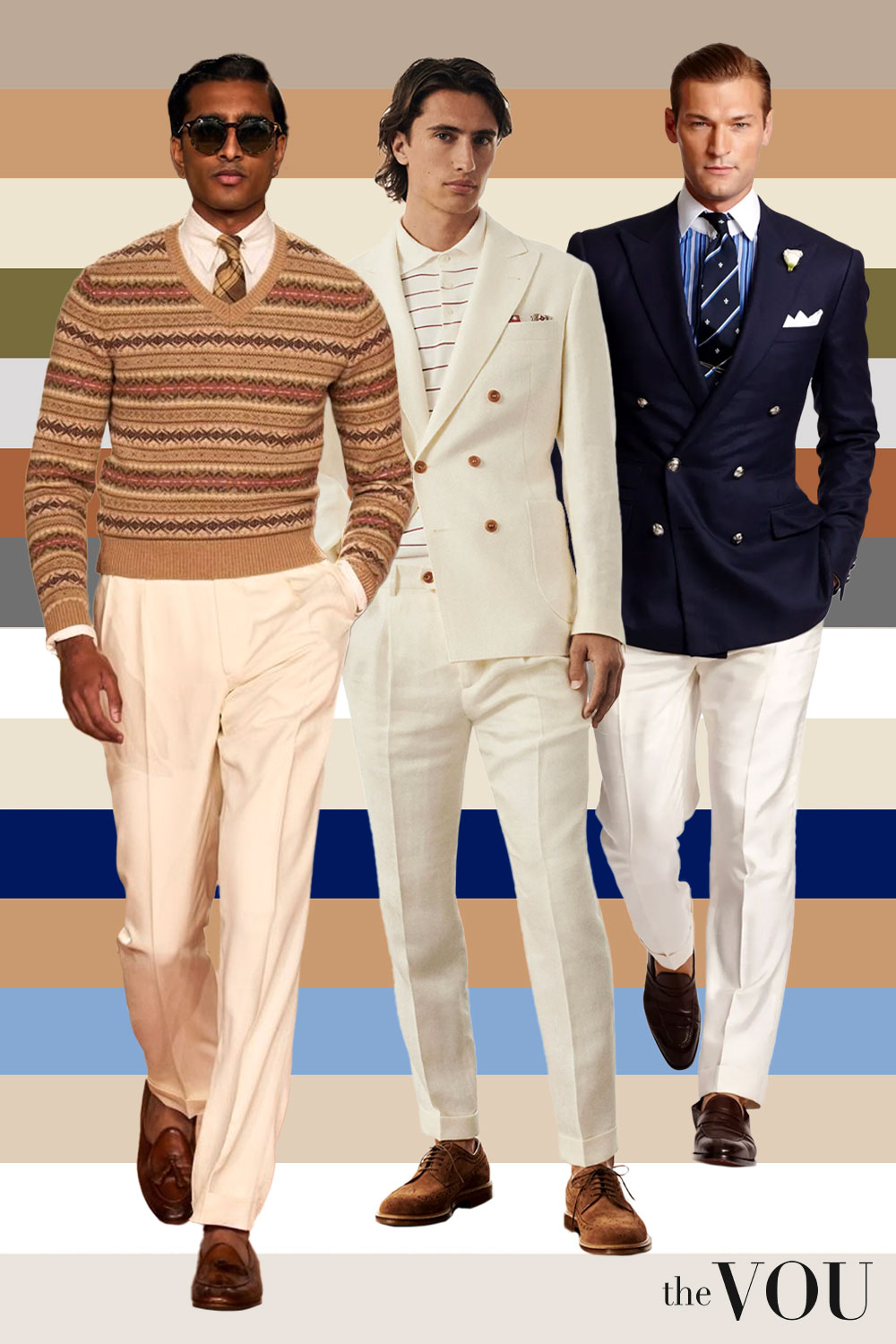
The image shows three outfits against a band of palette colours: a patterned brown and cream V-neck jumper with a tie and pale trousers, a cream double-breasted jacket over a striped knit shirt with cream trousers, and a navy double-breasted blazer with a light blue shirt, a striped tie and white trousers.
Base colours
Navy, charcoal grey, camel and cream are the base of the Old Money colours.
Navy is the usual alternative to black for daytime tailoring, charcoal goes with almost every other colour on this list, camel adds warmth, and cream is a softer choice than bright white.
Accent colours
Burgundy, forest green, rust and olive add depth without looking loud.
Burgundy suits ties and knitwear with navy and grey, forest green suits knitwear and outerwear, and rust and olive suit casual autumn clothes.
Combinations to try
Navy and camel: a navy blazer with camel trousers, or a camel overcoat over a navy suit.
Charcoal and burgundy: a charcoal suit with a pale blue shirt and a burgundy grenadine tie.
Forest green and cream: a forest green jumper over a cream Oxford shirt.
Navy and grey: a navy suit with a light grey shirt and a charcoal knitted tie for business.
Olive and camel: olive chinos with a camel roll-neck for the weekend.
Cream and light blue: cream linen trousers with a light blue Oxford shirt for summer.
Weather and time of year
In spring and summer, lighter shades such as cream, light grey and pale blue in linen and cotton keep outfits cool.
In autumn and winter, deeper shades such as burgundy, forest green and charcoal in flannel, tweed and knitwear add warmth.
If you are unsure which shade of a colour suits you best, compare two garments near your face in daylight; our guide to seasonal colour analysis explains one optional way of thinking about this.
The Old Money wardrobe
Shirts
Shirts are the base of most Old Money outfits, from a suit to a weekend jumper.
Shirt styles
Oxford cloth button-down: the most versatile shirt in the look, in white or light blue, with a soft, unlined collar that rolls naturally.
Poplin dress shirt: a smooth, finer shirt for suits and formal occasions, with a moderate spread collar and either barrel or double cuffs.
Bengal stripe shirt: narrow, evenly spaced stripes in blue or pink on white, which add a quiet pattern under a plain tie.
Tattersall check shirt: a country shirt with a fine check in colours such as navy or burgundy on cream, often in brushed cotton.
Linen shirt: white or pale blue for summer, with a soft collar.
Construction details
Mother-of-pearl buttons are a traditional detail, although they can still chip or crack, so keep a spare.
A split yoke, where the panel across the upper back is cut as two halves, can help a shirt sit well across the shoulders.
A gauntlet button on the sleeve opening stops the cuff from gaping.
Removable collar stays keep a dress shirt collar flat.
Fit
Collar: you should be able to slide two fingers inside it when it is buttoned.
Shoulders: the seam should sit at the edge of your shoulder.
Chest: the fabric should lie flat, with no pulling at the buttons.
Sleeves: the cuff should reach the wrist bone and show slightly below a jacket sleeve.
Care
Wash shirts after one or two wears to keep collars and cuffs clean, iron them slightly damp, and rotate them so that each one lasts longer.
Outfit ideas
Wear: an Oxford button-down with a navy blazer and grey flannel trousers.
Wear: a poplin dress shirt with a dark suit and a grenadine tie for formal events.
Wear: a Tattersall shirt with a lambswool jumper and corduroy trousers for a country weekend.
Wear: a linen shirt with cream chinos and suede loafers in summer.
Trousers
Classic trousers in good cloth are the base of both formal and casual outfits.
Trouser styles
Wool flannel trousers: soft, warm and slightly fuzzy, in mid grey, charcoal or navy.
Worsted wool trousers: smooth and smarter, for suits and formal occasions, in charcoal, navy or mid grey.
Cotton chinos: the casual staple, in khaki, stone, navy or olive.
Corduroy trousers: for autumn and winter, in brown, forest green or burgundy.
Linen trousers: for summer, in off-white, stone or pale blue, cut with a little room so the cloth can drape.
Construction details
Side adjusters instead of belt loops give a clean waist with tailoring.
A split-back waistband makes the waist easier to alter.
Pleats add room at the hip and thigh, while a flat front gives a slimmer line; both belong to the look.
Fit
Waist: the trousers should sit comfortably at the height you choose, without a belt holding them up.
Seat: smooth, with no horizontal pulling and no sagging.
Thigh: enough room to move and sit without strain.
Length: a slight break over the shoe for wool trousers, or little or none for casual cotton and linen.
Care
Brush wool trousers after wearing them, hang them by the hem or on felted clips to keep the crease, dry clean them only when needed, and press cotton and linen with a pressing cloth.
Outfit ideas
Wear: grey flannel trousers, a navy blazer and an Oxford shirt for a classic business casual look, with brown Chelsea boots in winter.
Wear: khaki chinos, a blue striped shirt and brown loafers at the weekend.
Wear: brown corduroy trousers, a cashmere jumper and suede chukka boots in autumn.
Knitwear
Knitwear adds warmth and texture to the look.
A knit’s gauge is how many stitches it has per inch: fine-gauge knits are thin enough to wear under a jacket, and chunky knits are casual layers in their own right.
Knitwear styles
Crew-neck jumper: in cashmere or fine merino, in navy, camel or forest green.
V-neck jumper: pairs well with a collared shirt and tie, in burgundy, navy or charcoal.
Cable knit: a textured jumper in a heavier wool, traditionally cream or oatmeal; the Aran jumper was hand-knitted on the Aran Islands and along Ireland’s west coast, and knitted jumpers became common there in the early twentieth century, according to the National Museum of Ireland.
Cardigan: a fine merino cardigan in navy, charcoal or camel can be worn under a blazer or on its own.
Roll-neck: a fine cashmere or merino roll-neck in navy, oatmeal or black for colder months.
Care
Hand wash or dry clean fine knitwear, store it folded rather than hung, use cedar to deter moths, and remove pills with a knitwear comb.
Outfit ideas
Wear: a fine V-neck jumper over an Oxford shirt with flannel trousers.
Wear: a cable knit with corduroy trousers and suede loafers in the country.
Wear: a roll-neck under a tweed blazer with wool trousers in winter.
Wear: a cardigan under a waxed cotton jacket with moleskin trousers.
Suits, blazers and sports jackets
Tailored jackets are the most recognisable garments in the look.
Suit styles
Single-breasted navy suit: the most versatile suit, with two buttons and notch lapels, in a mid-weight worsted wool you can wear for most of the year.
Charcoal double-breasted suit: a dressier choice, often in wool flannel, with peak lapels and a six-button front.
Brown tweed suit: a country suit for autumn and winter, often in herringbone; cloth sold as Harris Tweed has to be handwoven by islanders at their homes in the Outer Hebrides, as the Harris Tweed Act 1993 sets out.
Blazer and jacket styles
Navy hopsack blazer: an open-weave wool blazer that breathes well, with patch pockets, for smart-casual wear.
Navy serge blazer: a smoother, dressier blazer, sometimes with metal buttons.
Camel hair sports coat: a warm autumn and winter jacket, often with a three-roll-two button front.
Grey herringbone tweed jacket: a country and weekend jacket, sometimes with leather buttons and a ticket pocket.
Tan cotton gabardine jacket: a light jacket for spring and summer.
Forest green moleskin jacket: a soft, brushed cotton jacket for autumn.
Brown nailhead sports coat: a fine pin-dot weave that works for business and smart-casual wear.
Construction details
A full or half canvas helps the chest of a jacket keep its shape, and a soft lapel roll is one visible sign of it.
Horn or corozo buttons, working cuff buttons and double vents are traditional details, though none of them is required.
Fit
Shoulders: the jacket should end where your shoulders end, without overhang or dents.
Chest: the jacket should button without pulling.
Waist: a gentle shape is typical of the look rather than a very tight one.
Length: the jacket usually covers your seat.
Sleeves: show a little shirt cuff, about a quarter to half an inch (roughly 0.5 to 1.3 cm).
For more on proportions, see our guide to dressing for your body type, an optional framework rather than a requirement.
Care
Brush jackets after wearing them, hang them on wide shaped hangers, steam out creases, dry clean only when needed, and let a suit rest for a day between wears.
Outfit ideas
Wear: a navy suit, a white shirt, a burgundy grenadine tie and dark brown Oxfords.
Wear: a navy hopsack blazer, a white Oxford shirt, light grey tropical wool trousers and brown loafers in summer.
Wear: a camel hair sports coat, a cream roll-neck, chocolate brown trousers and suede boots in winter.
Wear: a grey herringbone jacket, a Tattersall shirt, moleskin trousers and brown brogues in the country.
Wear: a brown nailhead sports coat, a pale pink shirt and mid-grey flannel trousers for business casual.
Overcoats and outerwear
Outerwear is often the first garment people see in cold or wet weather, so choose classic shapes that sit over a jacket.
Outerwear styles
Trench coat: cotton gabardine, usually double-breasted and belted, in beige or navy, for rain and the in-between seasons.
Camel polo coat: a double-breasted camel coat, often with patch pockets and a half belt at the back.
Navy peacoat: a short, double-breasted coat in dense melton wool, for casual wear.
Waxed cotton jacket: a country jacket with large pockets and a corduroy collar, in olive or brown, re-waxed when it stops shedding water.
Cashmere or wool overcoat: a single-breasted, knee-length coat in charcoal or navy for formal winter wear.
Tweed shooting jacket: a country jacket with bellows pockets and room across the back for movement.
Loden coat: a dense, water-resistant boiled wool coat from the Alpine tradition, in green or grey.
Fit
An overcoat should close over a suit jacket or a thick jumper without strain, its sleeves should cover your jacket sleeves, and its collar should sit close to the neck.
Overcoats usually end around the knee, while peacoats and field jackets end around mid-thigh.
Outfit ideas
Wear: a trench coat over a navy suit on a wet working day.
Wear: a camel polo coat with grey flannel trousers and a cashmere scarf.
Wear: a navy peacoat with dark jeans and a cream Aran jumper at the weekend.
Wear: a waxed cotton jacket with moleskin trousers and brogue boots in the country.
Shoes
Shoes are a quick way to see whether an outfit has been put together with care.
Shoe styles
Oxford shoes: closed-lacing shoes in black for formal events and dark brown for business wear.
Penny loafers: slip-ons in calf or cordovan leather, in brown or burgundy, for smart-casual and business casual outfits.
Brogues: shoes with decorative perforations, in tan or mid-brown, for business casual and country wear.
Suede chukka boots: two or three-eyelet ankle boots in snuff or chocolate brown for smart-casual autumn and winter outfits.
Opera pumps: traditional black-tie slippers in patent leather or highly polished calf, with a grosgrain bow.
Dress boots: smooth calf boots with closed lacing for winter business wear, in dark brown or black.
Belgian loafers: soft, unlined slip-ons with a small bow, for summer evenings and relaxed occasions.
Horsebit loafers: slip-ons with a metal bit across the front, for business casual outfits.
Spectator shoes: two-tone shoes, such as brown and white, for summer garden parties and weddings.
Construction and fit
Goodyear-welted and other stitched soles can be replaced, which makes a good pair worth repairing.
Leave about half an inch between your longest toe and the end of the shoe, make sure the ball of your foot sits at the widest point of the shoe, and check that the heel does not slip much as you walk.
Care
Use cedar shoe trees, polish leather regularly, brush suede and protect it with a suede spray, and rotate your shoes so each pair dries out between wears.
Outfit ideas
Wear: penny loafers with chinos and an Oxford button-down for a classic preppy look.
Wear: suede chukka boots with dark jeans and a cashmere jumper for a smart casual look.
Wear: horsebit loafers with a navy blazer and grey flannel trousers for business casual.
Wear: spectator shoes with a seersucker suit or cream linen trousers at a summer event.
Accessories
Old Money accessories are few and plain, and they support the outfit rather than lead it.
Watches
A simple dress watch with a plain dial on a leather strap, or a steel watch for everyday wear, suits the look.
Classic designs often cited include the Cartier Tank, the Jaeger-LeCoultre Reverso and the Patek Philippe Calatrava, but many less expensive makers produce simple watches that give the same effect.
Ties
Choose silk or wool ties in repp stripes, small geometric patterns, paisley or plain colours such as navy, burgundy and forest green.
Grenadine and knitted ties add texture, and a tie width close to your lapel width keeps the proportions balanced.
Pocket squares
Choose silk, linen or cotton in plain colours or quiet patterns that complement, rather than match, your tie, and learn a simple straight or one-point fold.
Cufflinks
Simple cufflinks in silver or gold, with initials, a plain knot or a touch of mother-of-pearl, onyx or enamel, suit double-cuff shirts.
Belts
A full-grain leather belt with a plain buckle, in black, dark brown or tan to match your shoes, covers most outfits.
Scarves and leather goods
Plain or quietly patterned scarves in wool, cashmere or silk, and a well-made briefcase, wallet and key holder, complete the look.
Matching accessories
Keep metals in the same family, so your watch, cufflinks and buckle are all silver-toned or all gold-toned.
Match leather colours across belt, shoes and watch strap, and choose socks that match your trousers to keep a continuous line.
Hair and grooming
Neat, classic hair and simple grooming suit the look.
Classic Old Money hairstyles
The side parting: medium length on top with tapered sides, parted on whichever side your hair falls naturally, and finished with a little cream or pomade; it is one of the longest-standing looks in men’s grooming.
The Ivy League cut: a shorter version of the side parting, long enough on top to comb into a parting, with a natural taper at the sides and back.
The quiff: longer on top with shorter sides, styled with a light, natural-finish product.
The slicked-back cut: longer hair on top combed back with a shiny pomade, a style linked with the 1920s and 1930s.
Your barber can advise on which of these suits your hair type and how often to come back for a trim.
Facial hair, skin and hands
A clean shave, tidy stubble or a short, well-trimmed beard all fit the look.
Keep skincare simple: cleanse, moisturise and use sunscreen outdoors.
Keep nails short and clean, and moisturise your hands if they get dry.
Fragrances that suit the Old Money look
The six scents below are well-known classics, and the suggested outfits are our own pairings, not rules.
Try any fragrance on your skin before buying, because each one smells different on different people.
Vétiver by Guerlain
An earthy, woody scent built around vetiver, which suits the tweed jackets, corduroy trousers and brogues of British countryside chic.
Acqua di Parma Colonia
A light citrus cologne that suits the linen suits, loafers and open-collar shirts of Italian Old Money style in summer.
Creed Green Irish Tweed
A fresh, green scent that goes well with the Barbour jackets, wellington boots and cable knits of the Sloane Ranger style.
Terre d’Hermès
A woody, citrus and pepper scent created by Jean-Claude Ellena and launched in 2006, according to its Wikipedia entry, which suits city tailoring such as the suits and overcoats of the Yuppie style.
Penhaligon’s Blenheim Bouquet
A sharp citrus and lavender scent from the London perfumer Penhaligon’s, which suits formal daytime dress such as pinstripe suits and Oxford shoes, as well as crisp BCBG outfits.
Polo by Ralph Lauren
A green, mossy and leathery scent that suits the navy blazers, khaki chinos and penny loafers of Ivy League Preppy style.
How to wear fragrance
Choose lighter scents for the day and warmer ones for the evening, use one or two sprays on the neck or wrists, and let the fragrance dry without rubbing it in.
Quizzes and personal help from The VOU
None of these tools is needed to dress in the Old Money style, but some readers like extra help when choosing clothes.
You can read about choosing an image consultant and what an image consultant does, and our guides to dressing for your body shape and seasonal colour palettes explain two optional frameworks for thinking about proportion and colour.
For more on dressing for the setting, see styling by occasion, location, season and time of day.
For makers of the clothes in this guide, see our guide to classic menswear brands for the Old Money look.
For the vocabulary behind this guide, see our explainers on clothing, garments, fashion accessories, menswear silhouettes and outfits.
We also cover heritage fashion brands and how logo-heavy luxury designs come across, and our fashion style guide explains personal and historic styles.
1. Check your body shape
Check your body shape with the body shape quiz for men.
2. Find your seasonal colours
Find your seasonal colours with the seasonal colour quiz for men.
3. Take the fashion style quiz
Take the fashion style quiz for men to see which personal styles and outfit ideas match what you like wearing.
Book a consultation for personal help
If you would like personal help after the three quizzes, you can book one of our paid consultations with The VOU’s image consultants and stylists through our styling services for men, or contact us with questions.
Mandy Meyer’s focus at The VOU is men’s body-shape styling, garment fit and outfit proportions. Her coverage addresses the practical questions behind a wardrobe choice: how a jacket sits across the shoulders, how trousers fall and how different cuts change the silhouette a wearer wants to create.
Her subject areas include the triangle, inverted triangle, rectangle, oval, trapezoid, hourglass and diamond labels used in body-shape styling. These provide starting references for comparing visible proportions; they do not capture every body or prescribe one correct way to dress. The focus connects those observations with garment shape, construction, length and the relationship between the upper and lower parts of an outfit.
Mandy’s editorial coverage combines visual comparisons with fit checks for comfort and movement. Readers can consider whether a cut gives them the room they need, where clothing pulls or gathers and which changes might support their preferred look. The aim is to make menswear choices more understandable while keeping personal preferences and the wearer’s own styling goals central.