
Start here
What’s This About
Monochrome is a colour approach, not a dress code, so at formal events, follow the invitation first and use tonal colour only where it leaves room.
This guide works through formal and evening dress codes, such as
standard black tie and its white shirt
black tie optional with a dark suit
creative evenings where tonal colour is welcome
reception, cocktail and business formal tailoring
morning dress as a separate daytime convention
and many more!
Each section gives a complete outfit you can check against your own invitation.
Key Points
01Standard black tie keeps a white evening shirt and black bow tie, even when the rest of the outfit is dark.
02Black tie optional allows a dark suit with a white dress shirt, conservative tie and dress shoes.
03Green, magenta or caramel tailoring suits parties and receptions that welcome colour, not events with a stated formal code.
04Black shoes can be correct with navy or grey tailoring; there is no minimum number of shades or required fabric.
Monochrome is a colour approach, not a formal dress code. You can use related shades in a business suit or a creative evening outfit, but black tie and morning dress have their own conventions. A white shirt or black shoes may be correct even when they break a head-to-toe colour theme.
There is no minimum of three shades. Similar colours can be separated by texture, shape or finish. Begin with the invitation and venue, then use tonal choices within the room they leave you.
Standard black tie
A reliable conventional combination is a black dinner jacket with matching dinner trousers, a white evening shirt, black bow tie, black dress socks and black formal shoes. Use appropriate studs or cufflinks for the shirt. A suitable waist covering depends on the outfit and convention. Emily Post’s US guidance lists a cummerbund or waistcoat; Debrett’s British guidance treats these as optional, and says not to wear both together. Emily Post; Debrett’s.
The white shirt supplies contrast. Do not replace it with a black shirt or long tie merely to keep every garment dark. You can vary the surfaces of jacket, lapel facing and shoes without assembling unrelated black and charcoal suit garments.


The red-carpet looks in the first picture illustrate why a red-carpet reference is not a dress-code authority. A host may welcome a creative interpretation, but the photograph does not establish that your invitation does. No personal identity or colour season is inferred here.
Black tie optional
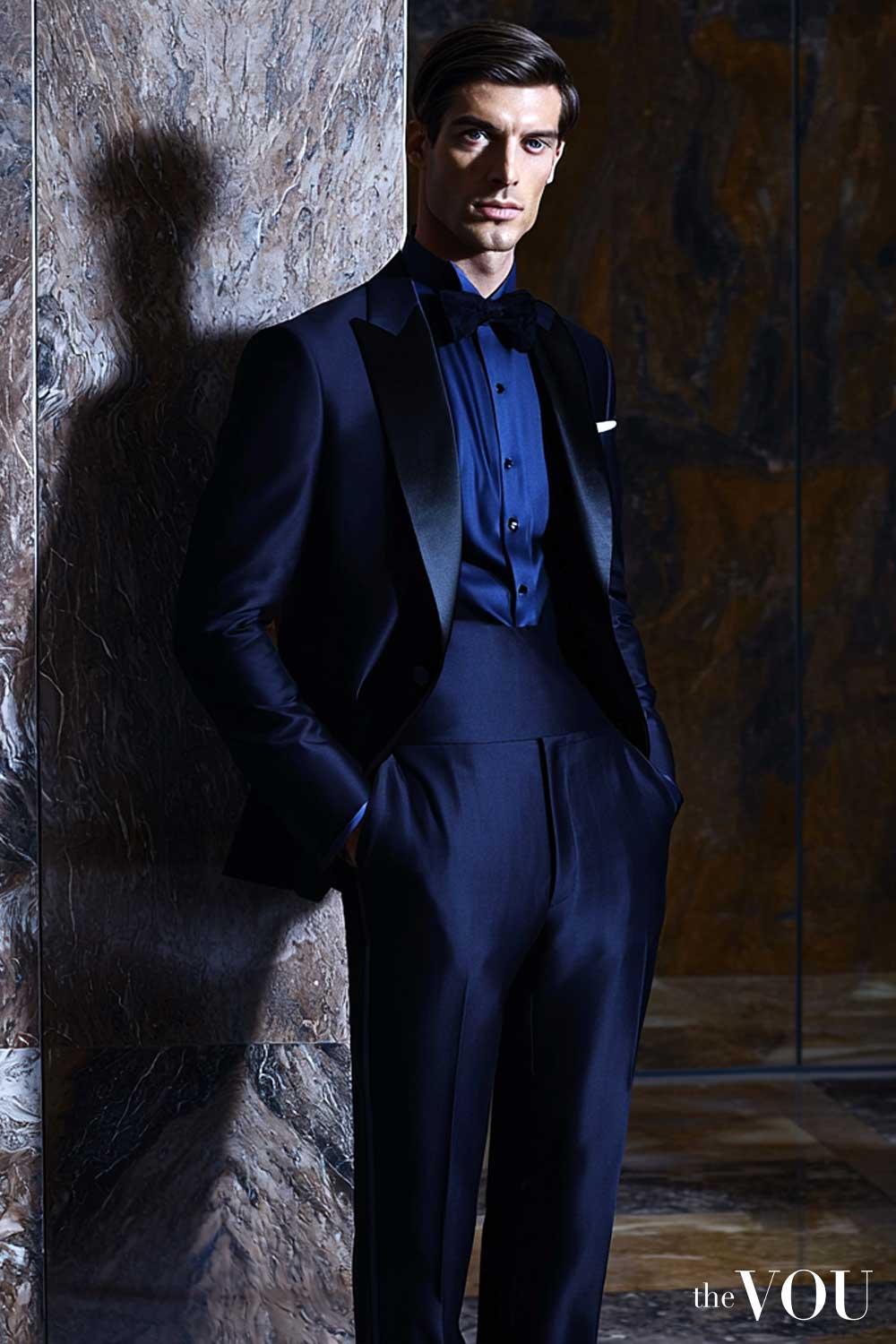
Black tie optional allows a tuxedo or a dark suit. For the suit route, Emily Post specifies a white dress shirt, conservative tie, dress shoes and dark socks. A dark navy suit with a white shirt, dark blue tie, navy socks and black lace-up shoes is a straightforward suggestion. The shirt and shoes need not match the navy.
“Optional” refers to the tuxedo alternative; it is not a general licence for an open collar, trainers or a coloured evening shirt. If the host provides more specific guidance, follow it.
Creative evenings where tonal colour is welcome
For a party or reception without a conventional formal code, green and magenta combinations can be useful starting ideas. Their texture and colour make them fashion choices, rather than proof of compliance with black tie.

A green adaptation. Deep green jacket, grey-green trousers, a fine dark green rollneck, dark socks and black loafers. The knit takes the place of a shirt and tie only when the event allows it. The grey-green trousers give the jacket some separation.
A purple adaptation. Aubergine jacket and trousers, a lighter purple shirt, dark socks and black lace-up shoes. Choose a quieter finish if the stronger sheen feels excessive. These are suggested combinations, not exact product or fabric identifications from the images.


For an invitation expressly stating creative black tie, retain its black-tie foundation and use only the variations the host permits. A coloured suit at an ordinary party and creative black tie are not automatically interchangeable.
Reception and cocktail tailoring

The grey and caramel examples show two useful approaches, a pattern within a restrained outfit and related warm neutrals. An open patterned shirt or V-neck knit can work at a relaxed reception. For an event requiring a suit and tie, replace it with a collared shirt and appropriate tie.
Try a medium grey suit, pale grey shirt, charcoal tie, grey socks and black lace-up shoes for a restrained version. For a daytime party that welcomes lighter tailoring, a caramel suit, cream shirt, brown socks and brown loafers offers a warmer alternative. Neither colour makes the outfit correct for every wedding or gala; check what the event asks for.


Business formal
Use your workplace’s expectations as the constraint. A dark navy suit with a pale blue shirt, navy tie, navy socks and black lace-up shoes gives a largely blue outfit with clear shirt contrast. A charcoal suit, light grey shirt, darker grey tie, grey socks and black shoes gives the corresponding grey version.


Try subtle texture, such as a textured tie against a smooth shirt. There is no need to specify Sea Island cotton, mohair or a luxury brand. Colour does not establish business acumen or trustworthiness, and an olive suit is not equally conventional in every office.
Morning dress, a separate daytime convention
Do not force morning dress into an all-grey formula. Following Debrett’s British guidance, use a black or grey morning coat, suitable grey or striped trousers, a waistcoat, a white or light shirt with a white turn-down collar, a tie and highly polished, non-patent black lace-up or smart slip-on shoes. Black socks and appropriate cufflinks complete a practical example. Follow the event’s specific hat requirements. Grey suede shoes and a grey silk shirt are not the default combination. See Debrett’s morning-dress guidance.

If you are hiring, tell the outfitter the exact dress code and event, rather than asking only for a monochrome formal outfit. Keep colour preference subordinate to those requirements.
Check the complete outfit
Put on the shirt, neckwear, socks and shoes with the tailoring. Check collar comfort, jacket closure and trouser length while standing and sitting. Choose cloth weight for the venue and weather; pale colours are not compulsory for summer events, nor velvet for winter ones.
Use a pocket square or jewellery only if it serves the outfit. A slight colour difference is optional, not an accessory rule. The monochrome dressing principles explain tonal choices, and the guide to seven complete monochrome looks distinguishes everyday outfits from fashion evening examples.
Common questions
Q. Can a black shirt replace a white evening shirt?
It can be a fashion or expressly permitted creative choice. It is not the conventional standard-black-tie example used here.
Q. Must formal shoes match the suit colour?
No. Conventional black shoes can be correct with navy or grey tailoring. Do not buy coloured patent shoes solely to maintain a monochrome theme.
Q. Do I need three shades or several expensive fabrics?
No. A well-fitting matching outfit can work. Different surfaces are an option; matching garments and correct dress-code details matter more than a prescribed fibre list.
Q. Can I wear burgundy or green to a formal wedding?
Only if the stated dress code and couple’s guidance permit that interpretation. “Wedding”, “gala” and “evening” describe events, not identical clothing requirements.
Related guides on The VOU
Black Tie Optional Dress Code Mastery for High Society Gentlemen
Complete Monochrome Dress Code for Men
What Are Textiles in Fashion? Complete Guide
Double-Breasted Suit Styling Guide for Modern Gentlemen
Black Suit Styling Mastery for Men
Tonal Dressing Style Guide for Men
Lounge Suit Dress Code Styling Mastery for Men
Navy Blazer Styling Guide for Gents
How to Choose and Style Oxford Shoes
Ultimate Dress Shoes Guide for Men
Formal Attire Dress Code Mastery for Men by Types and Occasions
What is Tailoring? A Beginner Guide for Gents
Complete Cocktail Attire Styling Guide for a Perfect Old Money Look
Parisian Chic Styling Guide for Maximum French Elegance
How to Style Penny Loafers for an Old Money Look
Business Formal Attire Styling Guide Masterclass for Modern Gentlemen
Men’s Suit Styling and Wearing Rules for an Impeccable Look
When and How to Wear a Morning Suit
Coat Over Suit Complete Styling Guide for Modern Gentlemen
How to Develop Your Personal Style
10 Styling Secrets for Men To Look Instantly Classy
Style Like A True Gentleman
Before you go, here is a simple way to put this guide into practice, and when to ask an image consultant for help.
Professional styling starts with knowing your body shape and seasonal colour palette, which help you choose clothes that fit well, in colours that suit your skin, eyes and hair.
Our guides also cover styling by occasion, location, season and time of day, garments, footwear, accessories and heritage fashion brands.
Take our three quizzes to find your body shape, seasonal colour palette and fashion style, then book a consultation if you want personal help.
1. Find Your Body Shape
Different garments flatter different silhouettes, so knowing your body shape is the first step in dressing like a confident man.
To find out your unique body shape, take our body shape quiz for men.
Once you know your unique body shape, take the second quiz to discover your unique colour palette.
2. Find Your Seasonal Colours
The garments in your outfits come in many colours, so it helps to check which colours suit your natural colouring.
To do that, you have to find out your seasonal colour palette, and you can do it by taking our seasonal colour quiz for men.
3. Find Your Fashion Style
By now, you should already know your body shape and unique colour palette; the next step is to discover your personal fashion style.
To find it, take our fashion style quiz for men; it includes a suggested style, outfit ideas, relevant fashion brands, and much more.
Personal Help from The VOU
For personal help, you can book a consultation with our image consultants and fashion stylists.
Our styling services for men are paid consultations; the shop page lists what each one includes.
Wearing luxury brands is not enough on its own (see our guide to logo-heavy luxury brands and how to wear them); knowing your body shape, colour palette and personal style first makes styling by occasion, location, season and time of day easier.
Contact us to book a consultation once you have taken the three quizzes.